
Wall mount garage door opener: when one fits your garage
The springs, the side room and the door it needs, from LiftMaster's, Chamberlain's and Genie's own manuals.
A wall mount garage door opener bolts to the wall beside the door and turns the torsion bar above it, so nothing hangs from the ceiling. It fits when the door runs on torsion springs, the end of that bar has 7 to 8.5 inches of clear wall beside it, and a grounded outlet sits within 6 feet.
LiftMaster, Chamberlain and Genie each build one, sold as wall mount, side mount or jackshaft openers. Protech Garage Doors sells, installs and repairs all three makers' openers, and the visit for garage door opener installation in Ottawa checks the springs and the room beside the door before anything is ordered. The clearances and limits below come from the makers' own manuals and pages.
What a wall mount opener is and how it works
A ceiling opener pulls the door along a rail with a trolley. A wall mount opener has no rail. It slides onto the end of the torsion bar, the steel shaft above the opening that carries the springs, and turns it. The drums on that bar wind up the lifting cables, and the door rises.
All three makers let it go on the left or the right of the door, so a garage with a side door or a window on one side can use the other. What it changes:
- The ceiling stays clear. Garaga's opener range says the wall mount design "frees up ceiling space in your garage, reduces noise and vibration."
- Less noise overhead. LiftMaster's 98032 product guide says it is built to minimise noise and vibration for living spaces above and next to the garage.
- High-lift tracks, which run up the wall before they turn, are allowed: up to 54 inches of high lift on the LiftMaster 98022 and the Chamberlain RJO20, and up to 84 inches on Genie's.
Protech is a Garaga dealer, and Garaga's residential range carries two wall mounts, both made by LiftMaster: the 98022 and the 98032. Both have a battery backup built in.
Why the springs decide whether it fits
Every one of the three makers limits its wall mount to doors with torsion springs. LiftMaster's 98022 user's guide says it in capitals: install on sectional doors with torsion assemblies only. Chamberlain's RJO20 owner's manual calls extension springs, the long springs that stretch beside the horizontal tracks, "NOT compatible".
Chamberlain adds that if a door does not meet its list, you must choose a different model of opener. Protech's Ottawa branch puts it the same way: a wall mount on an extension-spring door is not an option. How long the springs last shows how to tell the two kinds apart.
The torsion bar is checked as well. All three makers ask for:
- A bar 1 inch in diameter.
- Drums 4 to 6 inches across on a standard lift door. Chamberlain allows 3 to 3.9 inch drums on doors up to 430 lb.
- No reverse wound drums.
A garage short on headroom is not automatically a fit. LiftMaster rules out low headroom tracks with an outside pickup drum, and Genie low headroom outside hook-up, its words for reverse wound drums. On those doors, a different opener is the answer.
How much room it needs beside the door
Measure before choosing a model. Chamberlain's RJO20 manual and LiftMaster's quick start guide for the 98022 (document 114-5858-000) set the same minimums. Genie's installation instructions for its wall mount set its own:
| Measurement | LiftMaster 98022 and Chamberlain RJO20 | Genie wall mount |
|---|---|---|
| Side wall, or anything in the way, to the end of the torsion bar | 8.5 in. or more | 7 in. or more |
| Ceiling to the centre of the torsion bar | 3 in. or more | 2-1/4 in. or more |
| Wall above the door to the centre of the torsion bar | 2-1/2 in. or more | 2-1/2 to 6 in. |
| Torsion bar past its bearing plate | 1-1/2 in. or more | 2-1/4 in. or more |
| Grounded outlet | Within 6 ft | Within 6 ft |
Chamberlain measures the side room to "the side garage wall (or obstruction)", so a shelf or cabinet beside the door counts as the wall. LiftMaster's 98032 product guide gives the same 3 inches of headroom above the centre of the bar.
The outlet and the wall behind it
An outlet put in for a ceiling opener sits on the ceiling near that motor, which can be too far from the side of the door. A wall mount needs one within 6 feet of its own motor. LiftMaster says never to use an extension cord or a 2-wire adapter, so a new outlet comes first if there is none.
Genie adds that the opener must be bolted to the garage's framing, never to particle board or drywall.
Which doors each model can lift
The three makers publish close to the same size limits for the LiftMaster 98022 and 98032, the Chamberlain RJO20 and Genie's wall mount. The weight limits differ:
| Limit | LiftMaster | Chamberlain RJO20 | Genie |
|---|---|---|---|
| Door height | 14 ft | 14 ft | 14 ft |
| Door width | 18 ft | 18 ft | 18 ft |
| Door area | 180 sq. ft. (98022) | 180 sq. ft. | 180 sq. ft. |
| Door weight | 1,100 lb (98032) | Not stated | 850 lb |
| High lift | 54 in. | 54 in. | 84 in. |
Each figure is the most the maker allows, for a standard lift door unless the row says high lift. LiftMaster calls the 98032 the first and only UL certified residential opener that can lift doors up to 1,100 lb. Genie's 850 lb is the door's balanced weight, and Genie also takes vertical lift doors.
Genie's model 6072 page adds one door it will not take: a one-piece swing door.
Weight is set on the opener as well. LiftMaster's 98022 guide sets a door profile by drum size and counts doors with insulation, glass windows, a solid wood interior or decorations as standard to heavy. A door with a row of windows, like the ones in garage doors with windows, is one of those.
Slack cables and the automatic lock
A wall mount opener moves the door through its cables, so the makers watch them. Chamberlain's RJO20 will not close the door until its cable tension monitor is connected, and when the monitor senses slack the opener stops the door closing and sends it back up. Genie's has a Cable Keeper System that detects cable tension.
LiftMaster's 98032 product guide says that model no longer uses a cable tension monitor, while the box for the 98022 still lists one. What a loose or broken cable looks like, and what to leave alone, is in when a cable snaps.
The lock is the other part beside the door. LiftMaster's automatic garage door lock deadbolts the door into its track every time it closes. Chamberlain mounts its power door lock on the same side as the opener, within 10 feet of it, and names the third roller from the floor as the ideal spot.
What happens in a power outage
LiftMaster's 98022 guide says its battery runs the opener for up to 24 hours of operation in an outage. On battery it runs slower, and the lights, timer-to-close and closing from the myQ app are switched off.
The lock changes too. On battery, the automatic lock unlocks when the door is opened and stays off until the power comes back. For the rest of a long outage the door closes but is not deadbolted.
Long outages happen here. On 2022-05-21 the derecho cut power to 180,946 Hydro Ottawa customers, 54% of them, and 90% were back only by 6 p.m. on May 28. A battery rated for up to 24 hours covers the first day of an outage like that, not the week.
To open the door by hand, the 98022 guide says to release the lock first, then pull the emergency release handle down until it clicks, with the door closed if possible. Pull it down again to reconnect, and the door catches on the next run. Opening the door by hand covers why the door should be closed first.
When a wall mount opener is worth it
It earns its place when the door qualifies and the garage needs what it gives:
- The ceiling is needed for storage, or the door runs on a high-lift track.
- A bedroom or a room sits above or beside the garage.
- The door is on torsion springs, within the size limits, with the side room in the table.
It is the wrong opener when the door runs on extension springs, sits on reverse wound drums, swings up in one piece, or has less than 7 to 8.5 inches beside the end of the bar. Then a rail opener goes on the ceiling, and belt or chain drive covers that choice.
How Protech fits one
The makers put the door before the opener. LiftMaster's guide says to install the opener only on a properly balanced door, and to have any repair to cables and springs made by a trained technician before it goes on. Protech's Ottawa branch works in that order:
- The door is checked for balance first. On a door that has never been balanced, the visit starts with the springs.
- The spring type and the room at the side of the door are measured from Nepean before anything is ordered.
- The outlet is checked, because a wall mount needs its own beside the door.
- Travel and force are set on the day of the install, on that day's door, for the winter it will work in.
A worn or broken spring found on that visit is garage door spring repair in Ottawa, and the drive types for a ceiling opener are on garage door openers in Ottawa. At the other branches, see garage door opener installation in Mississauga and garage door opener installation in London.
Call (613) 845-9950 in Ottawa, (289) 975-9045 for Mississauga and the GTA, or (226) 270-9715 for London. Every line answers 24 hours. Say whether the door has torsion springs, how much wall there is beside it, and where the nearest outlet is.
Questions people ask
Short answers to what comes up most often.
Is a wall mount opener worth it?
Where the ceiling is needed, yes: Garaga says the design frees up ceiling space and reduces noise and vibration. It only fits a door on torsion springs with 7 to 8.5 inches of wall beside the end of the bar, depending on the maker. On extension springs or reverse wound drums, a ceiling opener is the choice.
How much room do you need beside the door?
LiftMaster and Chamberlain ask for 8.5 inches from the end of the torsion bar to the side wall, 3 inches from the ceiling to the centre of the bar, and an outlet within 6 feet. Genie asks for 7 inches at the side and 2-1/4 inches above the bar.
Can I install a wall mount opener myself?
LiftMaster says its 98022 is intended for installation only by trained garage door technicians and may need the springs or tracks adjusted. Chamberlain's retail RJO20 comes with a checklist the garage must pass first. Both makers say any repair to cables and springs is a technician's job before the opener goes on.
Does a wall mount opener work with extension springs?
No. LiftMaster, Chamberlain and Genie all limit their wall mounts to doors with torsion springs on a 1 inch bar. Chamberlain's manual says that if the door does not meet the list, you must choose a different model of opener.
Which is better, a Genie or a Chamberlain wall mount?
Neither maker ranks itself against the other, so compare the limits. Genie's lifts doors up to 850 lb balanced and needs 7 inches at the side and 2-1/4 inches above the bar. Chamberlain's RJO20 needs 8.5 and 3 inches, and takes up to 54 inches of high lift to Genie's 84. LiftMaster and Chamberlain are one company's two lines, as belt or chain drive explains.
Was there a recall on wall mount openers?
On 2023-02-09 Health Canada recalled LiftMaster myQ 889LM and 041A7928-3 control panels sold from March to October 2022, alone or packed with wall mount jackshaft openers including 8500 and RJO20 models. About 19,260 were sold in Canada. Owners were told to contact Chamberlain Group for a replacement panel.
Where to go from here
How a garage door opener is installed
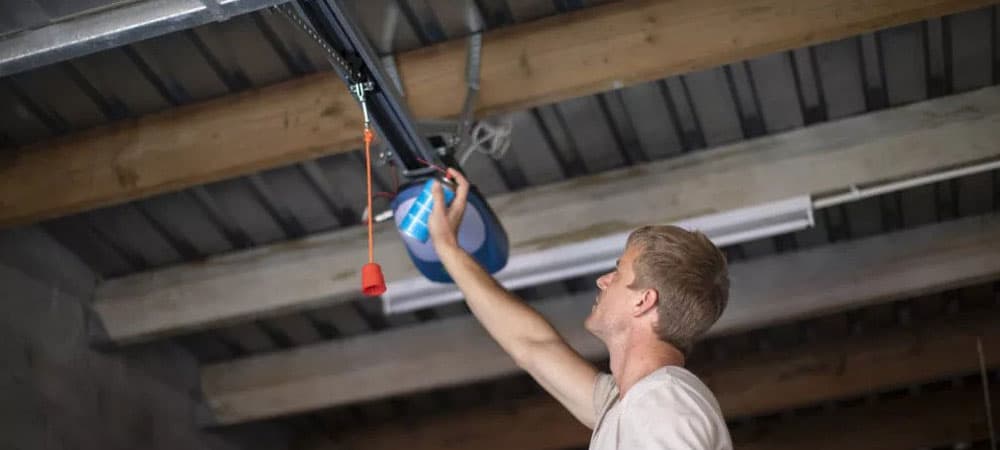
How a garage door opener is installed, step by step: tools, rail sizing, mounting, wiring and the safety reverse test. Protech serves Ottawa and the GTA.
Garage door openers
Chain, belt, screw and wall-mount openers from LiftMaster, Chamberlain and Genie. How drive type and horsepower are chosen, and when one is worth repairing.
Garage door spring repair
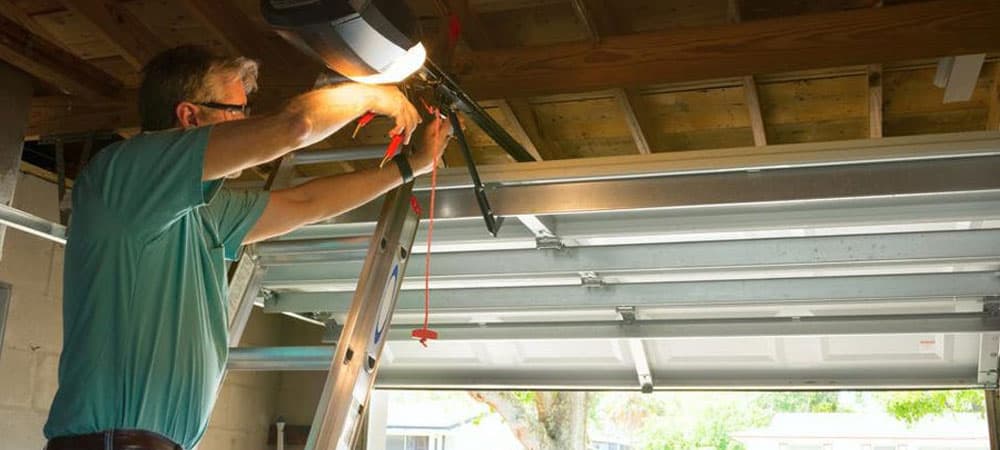
Broken garage door springs? We replace torsion and extension springs safely and professionally to get your garage door working properly again.
Garage door opener repair
Stripped gear kits, logic boards, limits and force settings, trolleys and remotes. What is worth repairing, and what is the door pretending to be the opener.
Talk to Protech Garage Doors today
Call (613) 845-9950 at any hour, or email info@protechgarage.ca for a new-door quote with no rush.