
How a garage door opener is installed: sizing and fitting a new unit
Fitting an opener is straightforward on a door that is in good order and difficult on one that is not, which is why the first thing that happens is a check of the door itself.
The door comes first
With the opener disconnected, a properly counterbalanced door lifts easily by hand and stays roughly where it is left at waist height. If it slams down or floats up, the springs need attention before an opener goes on. An opener fitted to an unbalanced door is being asked to do the springs job, and the gear kit is what pays for it.
Sizing
Weight decides horsepower. A light single door is comfortable on a half horsepower unit; a double, an insulated three-layer door, a wooden door or a carriage-style door wants three-quarters. Drive type is chosen on the building rather than the door: belt where there is a room above the garage, chain where noise does not matter, wall-mount where the ceiling has to stay clear or a car lift is going in.
Rail length is the measurement people miss. A standard rail suits a seven-foot-high door. An eight-foot door needs an extension kit, and a taller opening needs a longer rail again, so the door height is confirmed before the unit is ordered rather than discovered on the ladder.
Fitting
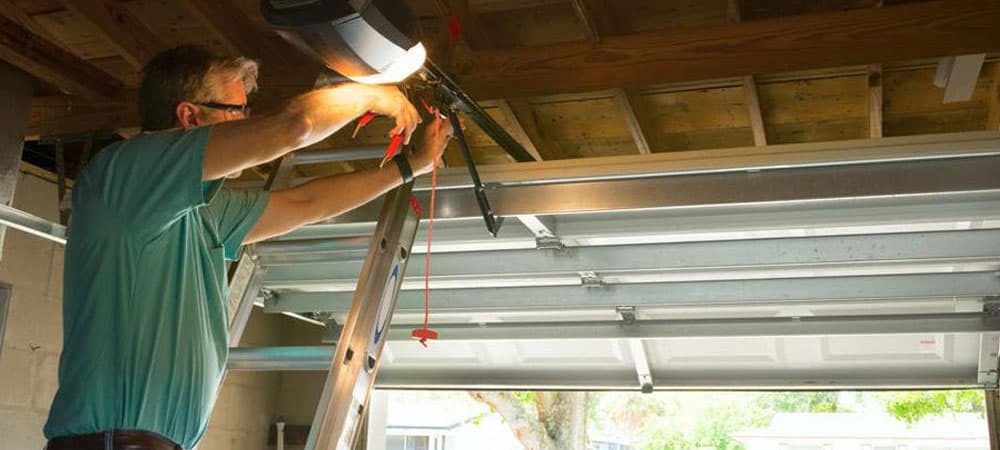
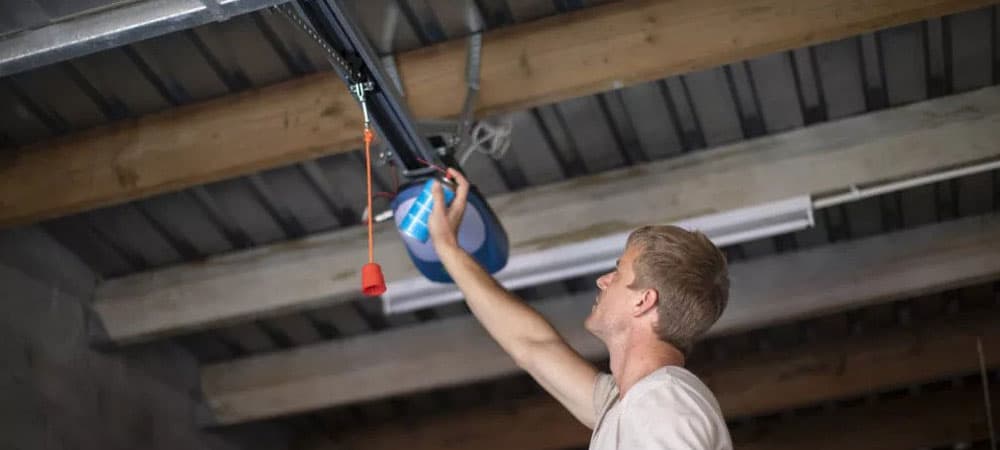
The motor head is hung from the ceiling on struts, not on the drywall, and squarely in line with the centre of the door. The rail is fixed to the header above the opening. The door arm connects to a bracket on the top section, and on a lightweight door that section gets a reinforcement strut, because an unreinforced top panel will flex and eventually tear around the bracket.
The photo eyes go on the vertical tracks near the floor, facing each other, and their wire is run back to the motor head clear of anything that will pinch it. The wall console goes where an adult can reach it and a child cannot easily.
An opener needs power at the ceiling, and adding an outlet where there is none is electrical work. The Electrical Safety Authority says the Ontario Electrical Safety Code requires almost all electrical work to be reported with a notification of work, filed before the work starts, and that a building permit is not the same thing. You may need both.
Setting it up
Travel limits tell the opener where the floor and the ceiling are. Force settings tell it how much resistance means an obstruction. Both are set on a balanced door, in that order, and then the safety reverse is tested against an obstruction on the floor. A door that does not reverse has not finished being installed, whatever the app says.
In the United States federal standard for residential openers, 16 CFR 1211.7, that test uses a solid object 1 inch (25.4 mm) high on the floor, and the closing door has to start reversing within 2 seconds of touching it.
Remotes, keypads and any app pairing are set up last, and the manual release is shown to whoever lives there, because the moment to learn where the red cord is and what it does is not during a power cut.
How to install a garage door opener: step-by-step guide
If your garage door is in good working order—balanced, with smooth tracks and intact springs—you can install an opener yourself. The steps below walk you through a typical residential installation. Safety warning: garage door springs are under extreme tension. Do not attempt to adjust or remove springs.
If the door isn’t operating perfectly, have it serviced first. Protech Garage Doors has certified technicians across Ottawa and the GTA who can get the door ready before you mount the opener.
1. Prepare the door and check balance. Disconnect the existing opener (if any) and lift the door manually. It should stay open about three feet off the ground without drifting. If it doesn’t, the door needs professional adjustment before an opener is installed.
2. Assemble the opener rail. Follow the manufacturer’s instructions to join the rail sections. Use the standard rail for a 7‑foot door; for an 8‑foot door you need the extension kit. Lightly lubricate the inside of the rail.
3. Mount the header bracket and motor unit. Find the center point above the door and fasten the header bracket into solid framing. Mount the motor unit on steel struts anchored to the ceiling joists—never to drywall alone. Align the rail with the header bracket.
4. Attach the trolley and door arm. Slide the trolley onto the rail. Connect the curved arm to the door bracket and the straight arm to the trolley. Adjust the connection so the door moves freely without scraping.
5. Install the safety sensors. Mount the photo‑eye sensors on each side of the door track, near the floor. Run the wires neatly to the motor unit, away from any moving parts.
6. Wire the wall control and power. Mount the wall console where an adult can reach it easily and a child cannot. Connect the control wires and the sensor wires to the motor unit terminals. Plug the opener into a grounded outlet.
7. Program travel limits and force settings. Use the opener’s learn button to set the up and down travel limits. Adjust the force settings so the door reverses with minimal resistance. Test the opener several times.
8. Perform the safety reverse test. Place a solid object 1 inch (25.4 mm) high flat on the floor under the door. Close the door. It must reverse within 2 seconds of contacting the object, per US federal standard 16 CFR 1211.7. If it doesn’t, adjust the down force and retest. Key takeaway: this test confirms the opener meets the required safety standard. Never skip it.
Where we do this
- Ottawa
- Mississauga
- London
- Brands installed and serviced
- Garaga, Amarr, Stanley, LiftMaster, Chamberlain, Genie
Related services
How an opener is installed: what people ask
Short answers on what usually breaks, what a visit involves and what it costs to put right.
Can I install a garage door opener myself?
The mounting is within reach of a confident DIYer. The parts that go wrong are the ones that look finished: limits and force set on an unbalanced door, a top section with no reinforcement strut, and a safety reverse that was never tested against an obstruction. Those are also the parts that matter.
If the door is already balanced and in good repair, the step‑by‑step guide above walks you through the full process. However, if the door is heavy, the springs are worn, or you’re unsure about wiring, a professional installation is safer. Protech Garage Doors has certified technicians who install openers from LiftMaster, Chamberlain, and Genie across Ottawa and the GTA—so if you hit a snag, help is a phone call away.
Do I need a new opener when I get a new door?
Not always, but the opener is checked against the new door weight. Insulated doors are heavier than the single-skin doors they often replace, so an opener that coped before can be underpowered afterwards. An old unit with no safety sensors is replaced regardless.
What is the reinforcement strut for?
It stiffens the top section so the opener arm pulls on the whole door rather than on one panel. Without it a lightweight top section flexes on every cycle and the bracket eventually tears out of it, which turns an opener job into a door section job.
What tools do I need to install a garage door opener?
You’ll need a stepladder, power drill with a socket set, tape measure, level, wrench set, wire strippers, and safety glasses. The opener kit includes the rail, motor unit, hardware, and sensors. If you’re missing a tool or run into trouble, Protech Garage Doors can complete the installation for you.
Everything else we repair and install
Every service the branch nearest you can send a van for.
Garage door repair
Broken springs, cables, rollers, tracks, sensors, trims and any garage door opener problem. Fast, professional service when you need it.
Emergency garage door repair
Emergency garage door repair for a door stuck open, a snapped spring or cable, or a door off its track. What to do before the call, and what to leave alone.
Garage door spring repair
Broken garage door springs? We replace torsion and extension springs safely and professionally to get your garage door working properly again.
Garage door safety sensors
Garage door safety sensors: the door starts down and reverses, or the opener light blinks. What the photo eyes are telling you, and when it is only alignment.
Garage door off track
Garage door off track or not moving properly? Protech can safely realign the door, repair damaged tracks, replace rollers and get it running smoothly again.
Garage door parts
Springs, cables, drums, rollers, hinges, brackets, seals and opener parts. What is on the truck, what is matched to the door, and what is not a DIY part.
Talk to Protech Garage Doors today
Call (613) 845-9950 at any hour, or email info@protechgarage.ca for a new-door quote with no rush.